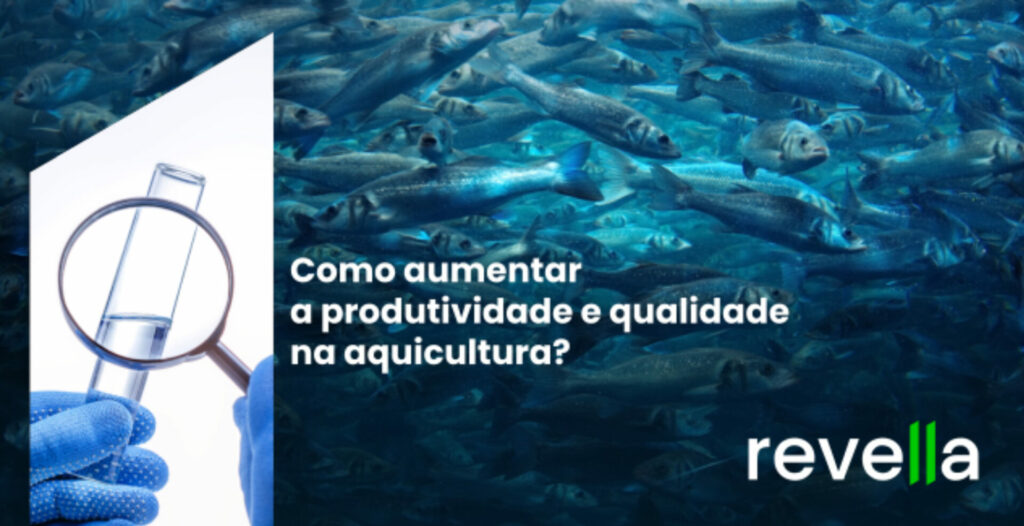
Developing technologies that reduce losses and increase productivity, quality and health in aquaculture are key to the sector's growth.
However, farmed fish are susceptible to losses due to infectious diseases, inadequate handling and poor management, which can significantly reduce profits.
Want to know how to increase aquaculture productivity? Read on!
What is aquaculture?
First of all, according to the FAO, aquaculture is defined as the practice that covers all activities related to the cultivation of aquatic organisms, for example:
- Fish,
- Molluscs,
- Crustaceans,
- Aquatic plants,
- Reptiles
- Amphibians
- In controlled environments, such as tanks, ponds or enclosed oceans.
Aquaculture has become an essential part of food production, especially in the face of population growth and the demand for animal proteins.
This practice offers an alternative to traditional fishing, helping to reduce pressure on dwindling fish stocks due to overexploitation and environmental degradation.
In addition, aquaculture can be adapted to different climates and regions, allowing communities around the world to grow aquatic food and improve their food security.
Read more: Nanotechnology in the agricultural sector: how Revella influences the segment
The importance of aquaculture
Aquaculture has grown and increased its share of the country's economy. According to IBGE research, aquaculture production increased by 16.6% in Brazil from 2022 to 2023, generating R$10.2 billion.
Fish production exceeded 655,000 tons, setting a new record.
At the same time, shrimp farming reached more than 127,000 tons, registering growth of 13% compared to 2022, with a total production value of R$2.63 billion.
Aquaculture production market
It is estimated that the Brazilian fishing and aquaculture market will reach US$149.01 billion by 2024 and could reach US$176.97 billion by 2029, with annual growth of 3.5% between 2024 and 2029.
Aquaculture is one of Brazil's main sectors, with more than 80% of it focused on freshwater production. The country is focusing on this sector, driven by increased interest from both national and international investors.
Brazil currently ranks second in aquaculture production in Latin America and the Caribbean.
Despite still relying on seafood imports to meet domestic demand, local production could soon compete with imported products.
The most produced fish in Brazil is tilapia.
In 2023, its production corresponded to 67.5% of the total species produced, and the municipality that stood out as the largest producer of fish farming was Morada Nova de Minas (MG), which increased its production exponentially and now accounts for 3.1% of national production.
As for shrimp farming, 99% of production is concentrated in the Northeast: Ceará (57%) and Rio Grande do Norte (19.4%), while the state of Santa Catarina is the largest producer of oysters, scallops and mussels: malacoculture.
In 2023, this production amounted to 8,700 tons and generated a value of R$102.5 million.
Read more: Revella Agritech: Nano and Biotechnologies for agro.
Increasing productivity in aquaculture to fight hunger
The 2024 edition of the "State of World Fisheries and Aquaculture" (SOFIA) report indicated for the first time that aquaculture production has overtaken extractive fishing to become the main source of fish and seafood products.
This progress opens up new opportunities to tackle global hunger and protect the oceans at the same time.
735 million people face hunger, it is essential to act quickly to reduce this number.
The FAO emphasizes that aquaculture represents an effective solution for increasing food production and improving access to food.
It also has the task of guaranteeing:
- Food quality;
- Protein supply;
- Nutrition;
- Generating jobs for the population.
In other words, we must continue working to support the growth of the world's population, whether through food production or job creation.
The development of technologies to increase health and productivity in aquaculture should be the focus of many different economic sectors, due to its social importance.
Read more: Biologicals in agribusiness: learn about the science behind it
Aquaculture research: contributing to production and health systems
Currently, research in the aquaculture area is looking for answers to help increase production and the health of systems, in order to contribute to the sector's appreciation.
In other words, the focus of these studies is on management, health and feeding methods that make it possible to increase aquaculture productivity with low economic and environmental impact.
Aquaculture's main difficulty
One of the great difficulties facing aquaculture today is containing the spread of diseases, especially those caused by bacteria that can pose a risk to both production and consumer health.
In this sense, methods involving vaccination and the use of antibiotics can be an ally in controlling these infestations.
However, good management practices related to feeding, water quality, oxygenation and reducing the organic load in these structures contribute to the health of farming systems and are a priority for producers.
Research into the use of nanotechnology has shown promise in improving the health of fish reared in aquaculture systems, and could be another important ally in management systems.
Nowadays, highly selective nanotechnological sensors can be used to detect pathogens in aquaculture water, which can help optimize production processes.
Read more: Revella test: Biosensors for detecting Salmonella spp.
Innovation and technology: advances in the productive sector
First of all, it should be remembered that innovation, technology and production are concepts that go hand in hand today.
Currently, the resources made available by the technology market have translated into increased productivity, quality and process optimization, bringing benefits to the entire sector.
In this sense, nanotechnology can be seen as an important resource that is appearing more and more frequently in the different stages of the production chain.
Combining scientific knowledge and technological development, Revella Tech offers solutions that meet the health demands of the sector in an efficient and sustainable way.
With antimicrobial solutions based on nanotechnology, Revella's solutions are innovative and stand out in the sector both by helping to combat pathogens and by inhibiting cross-infections.
Find out more about this and other technologies developed by Revella.
Contact us here and our team of experts will be ready to assist you.
Nanotechnology for agriculture: increase the performance of your products
Revella has expertise in developing additives focused on high performance and sustainability for the agro-industry.
Get in touch with our experts and find out more about our products that make up various agricultural inputs, such as fertilizers, adjuvants and seed treatment.