Climatic conditions and the use of agricultural technologies make Brazil a major grain producer and exporter
In this scenario, corn stands out as one of the crops with the largest share of the national and international market.
Furthermore, investing in the development of solutions that bring technological improvements to inputs makes it possible to increase productivity year after year.
With this in mind, Revella Agritech offers the best in innovation in the industry through agricultural technologies that contribute to the development of agribusiness.
Maize cultivation in Brazil
According to Conab (National Supply Company), Brazil is expected to produce 124 million tons of corn for the 2022/2023 harvest, 9% more than the 2021/2022 harvest.
While most of the world's producers have environmental limitations, our country is able to grow and store this grain all year round.
Initially, only the summer crop featured prominently, but with the development of different agricultural technologies, it has become possible to grow corn in different regions and at different times of the year, making it an important source of employment.
As a result, corn has become a crop of diversified importance, standing out not only as a raw material for human consumption, but also for the production of ethanol and animal feed.
Read more: Using technology to increase productivity in agriculture
The importance of corn in food
Like so many other species, corn is of great importance in human and animal nutrition.
In the context of human nutrition, it can be included in the diet in the form of flour, grain or even as a base for various food products.
This grain is a food with high nutritional value, a source of macro and micronutrients, proteins, carbohydrates, carotenoids, vitamin E, unsaturated fatty acids, antioxidants and fiber.
As a result, eating this food helps to balance the body's activities, preventing degenerative and cardiovascular diseases, as well as neurological damage and cancer.
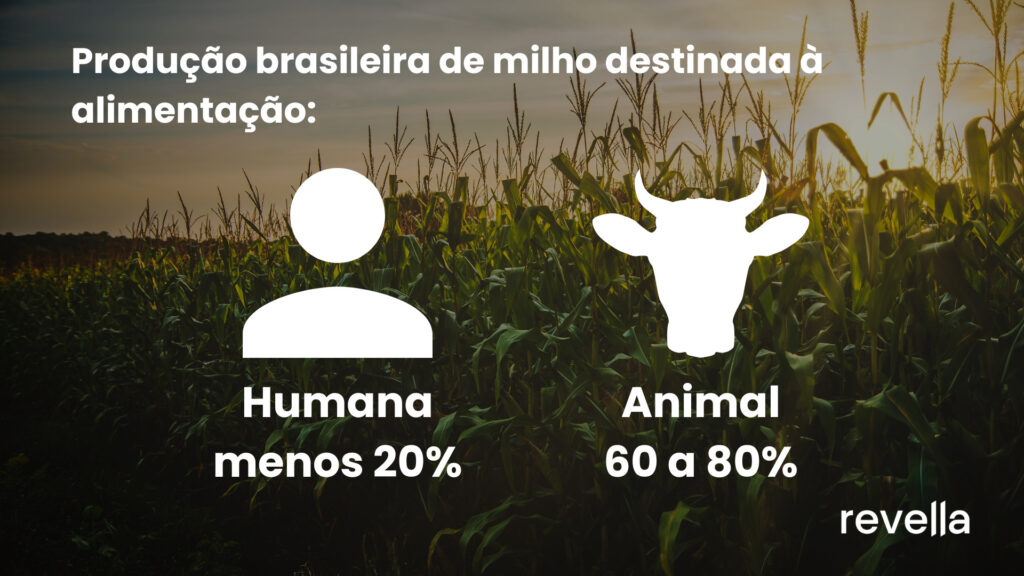
It is estimated that less than 20% of Brazil's corn production is destined for human consumption.
Animal feed, on the other hand, demands between 60 and 80% of corn production, according to Embrapa.
It is therefore possible to observe the use of this grain on small, medium and large farms, whether in the form of bran, grain or feed.
There are many factors that make corn a high-quality, low-cost food that serves as the basis for human and animal nutrition.
In this sense, Revella Agritech wants to help increase productivity, as it sees a continuous demand for this cereal.
Read more in: Nanoparticles in fruit: Learn about the benefits
National corn ethanol production
Its high versatility makes corn stand out as a raw material for ethanol production.
The agricultural scenario for growing corn is expanding, with growth of 800% in the last 5 years, reaching a production of 4.5 billion liters in the 2022/2023 harvest.
According to Unem (National Corn Ethanol Union), corn ethanol production should reach 10 billion liters by 2030, increasing its share of the national market.
While sugar cane has limitations when it comes to growing and storing it, corn has adapted cultivars that can be grown and stored all year round.
Therefore, this corn-based biofuel becomes an important ally in the low-carbon energy transition, mitigating greenhouse gas emissions.
High internal and external demands demonstrate the need for developments that increase productivity, making Revella additives indispensable.
Download the E-book: Technologies in foliar treatment
Challenges in growing corn
Challenges such as pests and diseases are among the main problems facing national grain production.
The corn leafhopper is currently one of the main causes of losses, which can reach up to 70%.
In this scenario, experts are looking for technological solutions that can help manage and reduce the action of these insects
This is why insecticides are commonly used in conventional agriculture, from the north to the south of the country.
According to Siagro (Monitoring System for the Trade and Use of Pesticides in the State of Paraná), 2.3 million liters of insecticides were consumed in the second corn crop of 2021/2022 in the state of Paraná alone.
However, one of the major problems with the high use of agrochemicals is the selection of resistant organisms, which make their management increasingly difficult.
Investing in crop management that makes plantations healthier is the focus, and in this scenario Revella can help agribusiness by bringing agricultural technologies to the segment.
Read more: Nanotechnology in the agricultural sector: how Revella influences the segment
Agricultural technologies are the future of agribusiness
Nanotechnology is already part of numerous sectors in the world market, with investment of US$70 billion expected by 2026.

On the other hand, in the agro market, the participation of products with agricultural technologies such as nano-scale particles is still timid, and there is a lot of room for development of products in the sector.
Above all, this technology has become increasingly popular due to its numerous benefits and applications, contributing through:
- Controlled release of agrochemicals;
- Better use of nutrients and biostimulants;
- Pest and disease control;
- Sensors and biosensors;
- Protection and enhancement of biological products;
- Environmental preservation.
The benefits of nanotechnology make it a trend for the coming years.
Seeing the potential of this market, Revella is investing in the present by developing agricultural technologies using micro and nanotechnologies in different applications.
Read more: How to increase productivity and quality in aquaculture?
Boost your products and gain more productivity
Revella additives have proven their efficiency, boosting the results of agricultural inputs.
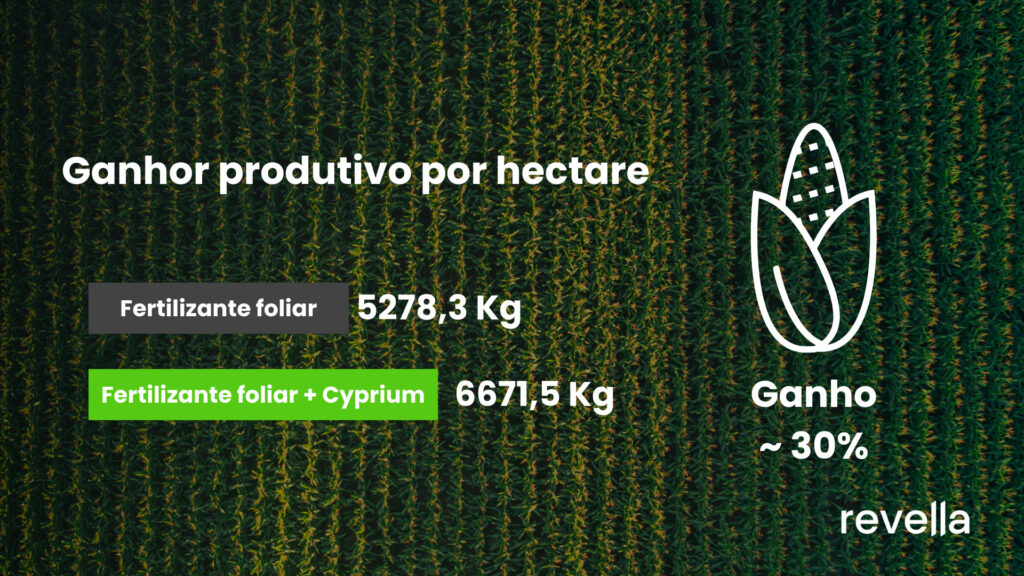
The results in corn crops showed that the use of Cyprium together with foliar fertilizers increased yields by 30%.
Likewise, the synergy between active ingredients resulted in a 15% drop in the incidence of rust, once again proving the efficiency of the Arbo additive in crops.
Our LarvShield additive, with its natural capsules, has been proven to be effective in helping to manage pests without selecting for resistance.
Revella's technology guarantees stable formulations, with natural, biodegradable and highly efficient raw materials, contributing directly or indirectly to your crops and the environment.
Our additives help with nutrition, metabolism and stimulate plant resistance, making them better able to thrive.
Through its agricultural technologies, Revella therefore brings benefits to crops, either by increasing production or by reducing the use of inputs in a sustainable way without accumulating them in the environment.
Read more: Biologicals in agribusiness: learn about the science behind it
Did you like the post?
Want to know more? Get in touch with our team of experts and find out how we can help you.
Don't forget to share it on your social networks! Access more exclusive content by subscribing to our YouTube channel, following our blog and following Revella on LinkedIn, Facebook and Instagram.